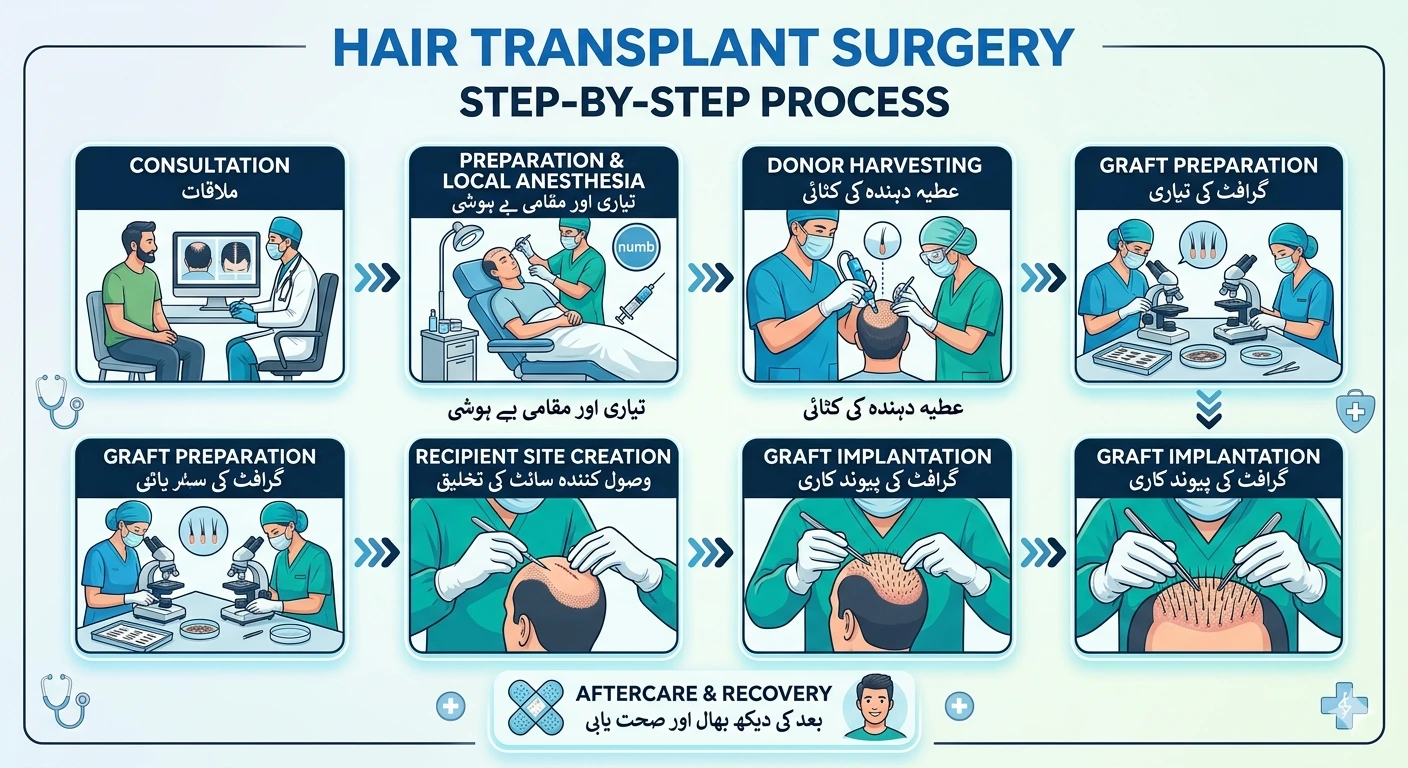
Hair loss is a common problem that many people face today. It can happen because of age, stress, poor diet, or family history. Losing hair can make a person feel less confident, and that is why people look for solutions. Some try oils, shampoos, and medicines, but these do not always give strong or permanent results. That is why many people now choose professional treatments from trusted clinics like Institute Cosmetique, which is known for providing the Best Hair Transplant in Lahore with safe and modern methods.
Hair transplant surgery is one of the best ways to restore lost hair. It is a medical procedure that uses your own hair to cover bald areas. In this article, you will learn the step-by-step process of hair transplant surgery in very simple and easy English so anyone can understand it without difficulty.
What is Hair Transplant Surgery?
Hair transplant is a process where doctors take healthy hair from one part of your head and move it to another part where hair is thin or missing. The area from where hair is taken is called the donor area, and the area where hair is placed is called the recipient area.
This method gives natural results because your own hair is used. Once the new hair starts growing, it usually stays for many years. Hair transplant is often used for people who have bald spots or thinning hair due to genetics or medical conditions.
Step 1: Consultation with the Doctor
The first and most important step is meeting a hair specialist. In this meeting, the doctor carefully checks your hair and scalp. They look at how much hair you have lost and also examine the donor area to see if it has enough healthy hair.
The doctor will also ask about your health, lifestyle, and any medicines you are taking. This helps them decide if you are a good candidate for the procedure. After this, the doctor creates a treatment plan based on your needs and expectations.
Step 2: Designing the Hairline
After the consultation, the next step is to design your new hairline. This is a very important part of the process because it decides how your hair will look in the future.
The doctor draws a natural-looking hairline based on your face shape and age. A good hairline should not look fake or too straight. It should match your natural hair pattern so that the final result looks real and balanced.
Step 3: Preparing the Donor Area
Now the doctor prepares the donor area, which is usually the back or sides of the head. Hair in this area is strong and does not fall easily.
The hair in this area is trimmed or shaved so that the doctor can work easily. Then the scalp is cleaned properly to prevent infection. After that, local anesthesia is given to make the area numb. This means you will not feel pain during the procedure, although you may feel slight pressure.
Step 4: Extracting the Hair Follicles
In this step, the doctor removes hair follicles from the donor area. Hair follicles are the roots of the hair.
There are two main methods used:
FUE (Follicular Unit Extraction):
In this method, hair follicles are removed one by one using a small tool. This method is popular because it leaves very small marks and heals quickly.
FUT (Follicular Unit Transplantation):
In this method, a small strip of skin is removed, and then hair follicles are separated from it.
Most modern clinics prefer FUE because it is less invasive and gives faster recovery. After removal, the follicles are placed in a special liquid to keep them safe and healthy.
Step 5: Preparing the Bald Area
Once the hair follicles are ready, the doctor prepares the area where hair will be placed. This area is also cleaned and numbed using anesthesia.
The doctor then makes very small holes or cuts in the skin. These tiny openings are very important because they decide how the new hair will grow. The doctor carefully plans the direction, angle, and spacing so that the hair looks natural after it grows.
Step 6: Implanting the Hair Follicles
Now comes the main step, where the doctor places each hair follicle into the small holes in the bald area. This process requires a lot of care and skill.
Each hair is placed at the right angle and in the correct direction so that it matches the natural hair. The doctor also controls how thick or dense the hair will look. This step can take several hours depending on how many grafts are needed.
Step 7: After Surgery Care
After the procedure is complete, the doctor cleans your scalp and may apply a light bandage. You will be given medicines to prevent pain and infection.
The doctor will also give you instructions on how to take care of your hair at home. Most people can go back home on the same day, but they must follow all the advice carefully for better results.
Step 8: Recovery and Hair Growth
Hair transplant results take time, so patience is very important. In the first few days, you may notice slight swelling or redness, which is normal.
After about a week, small scabs form and then fall off. Within 2 to 3 weeks, the transplanted hair may fall out. This can feel worrying, but it is a normal part of the process.
New hair usually starts growing after 3 to 4 months. Full results can be seen after 9 to 12 months. In some cases, it may take longer depending on the person.
Important Aftercare Tips
Aftercare plays a big role in getting good results. You should avoid touching or scratching your scalp. Always take your medicines on time and follow your doctor’s instructions.
Avoid heavy exercise and protect your head from direct sunlight. Use a mild shampoo when your doctor allows it. Good care will help your hair grow better and faster.
Is Hair Transplant Safe?
Hair transplant is generally safe when it is done by a trained and experienced doctor. It is a minor procedure and does not involve major risk. Since local anesthesia is used, pain is very low.
However, choosing the right clinic is very important. A skilled doctor can give you natural-looking and long-lasting results.
Frequently Asked Questions (FAQ)
1. Is hair transplant painful?
No, the procedure is not painful because the area is made numb. You may feel slight discomfort after surgery.
2. How long does the surgery take?
It usually takes 4 to 8 hours, depending on the number of hair grafts.
3. When will I see hair growth?
New hair starts growing after 3 to 4 months, and full results take up to a year.
4. Is hair transplant permanent?
Yes, in most cases, the transplanted hair lasts for many years.
5. Can the transplant fail?
Failure is rare but can happen if the procedure is not done properly or aftercare is ignored.
6. How long is recovery time?
Basic recovery takes about 7 to 10 days, but full healing takes a few weeks.
Final Words
Hair transplant surgery is a complete step-by-step process that helps bring back natural hair. It includes consultation, planning, extraction, and implantation. Although it takes time to see full results, it can give long-lasting and natural-looking hair.